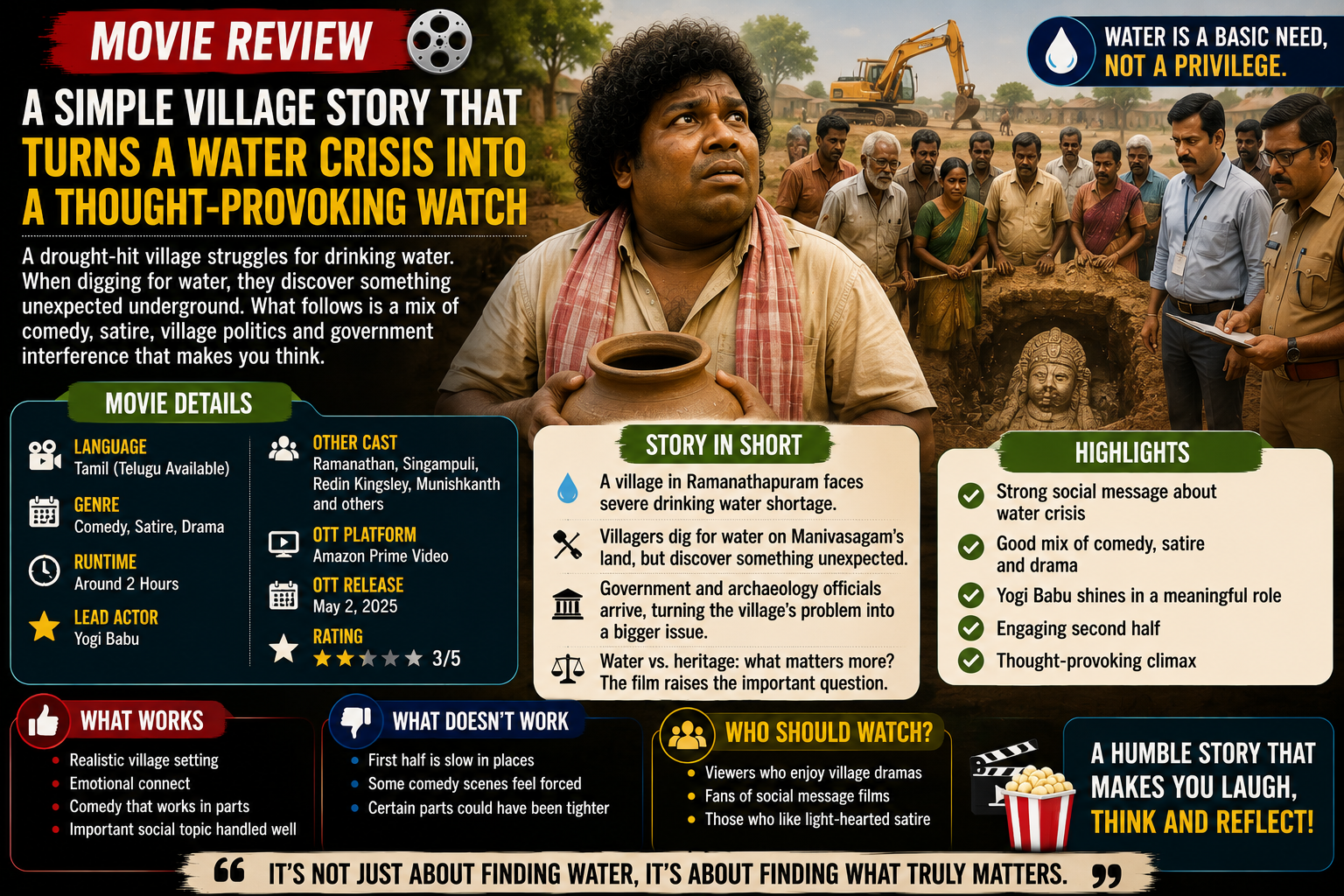
A Simple Village Story That Turns a Water Crisis into a Thought-Provoking Watch
Some movies try to entertain the audience with big action sequences and commercial elements, while others focus on an everyday problem that affects ordinary people. This one belongs to the second category. Set in a drought-hit village in Tamil Nadu, the story revolves around people struggling for something as basic as drinking water. What begins as an attempt to find a water source slowly turns into a situation involving government authorities, archaeology officials, village politics and the unexpected discovery beneath the ground. Code : 17

The film has a simple premise, but the subject it chooses to discuss is important. Instead of concentrating only on one individual’s problem, the story presents the water crisis as a collective issue faced by an entire village. That gives the film a social angle while still keeping the proceedings within the space of comedy, satire and rural drama.
Story and Premise
The story takes place in a small village in the Ramanathapuram district. The village has only a limited number of houses, and one of the biggest problems faced by the residents is the shortage of drinking water. The villagers have repeatedly approached the government for help, but their problem continues without any proper solution.
With no other option left, the villagers decide to find out whether there is a possibility of getting water somewhere inside the village itself. They approach an elderly man who knows about the area and eventually learn that there may be a water source near the land belonging to Manivasagam.
Manivasagam agrees to give his land for the benefit of the entire village. The villagers begin digging with the hope that they will finally discover water. However, what they find underground is completely different from what they expected.
Instead of water, something unexpected is discovered beneath the ground. This discovery suddenly changes the direction of the story. Government authorities from the central level become involved, and officials arrive at the village to investigate the discovery.
From this point, the film combines the village’s drinking-water problem with the mystery surrounding what has been found underground. The villagers want their basic needs to be addressed, while the authorities have their own reasons for being interested in the discovery.
That combination forms the central storyline.
How Is the First Half?
The movie takes some time to establish its characters and the situation in the village. The initial portions focus heavily on the water shortage and the difficulties faced by the residents.
The biggest positive here is that the film doesn’t treat the water problem as just a background detail. It actually shows how a lack of drinking water affects people’s everyday lives. For the villagers, this isn’t a temporary inconvenience. It is something that influences their relationships, their future plans and even important decisions in their lives.
The protagonist’s personal life is also connected to the water crisis. His marriage prospects are affected because of the difficult circumstances in the village. These portions give the audience an idea of how deeply the problem has entered the lives of ordinary people.
At the same time, the film tries to bring comedy into the proceedings. Some jokes work because they come naturally from the characters and their circumstances, while a few other portions feel more like they were added to maintain the entertainment factor.
The film is not designed as a serious political drama from beginning to end. It uses satire and humour to talk about a genuine social issue.
The Central Idea Works
One of the strongest aspects of the film is its central idea.
Drinking water is something most people take for granted, but there are still villages where getting clean water can become a daily struggle. The movie uses this situation to show the difficulties faced by people living in areas where basic resources are limited.
The story also makes an interesting point about how authorities sometimes react differently when something valuable or historically important is discovered.
When the villagers are struggling to get water, their problem does not receive the kind of attention they expect. But once something potentially valuable is found underground, officials suddenly become interested in the location.
That contrast gives the film its satirical flavour.
The movie therefore isn’t simply saying that the village needs water. It also questions what society considers valuable and how people in power respond when something of historical or financial importance is discovered.
Yogi Babu’s Performance
Yogi Babu carries a major portion of the film on his shoulders. His character is written as an ordinary village man who is directly affected by the circumstances around him.
This type of character suits Yogi Babu well. He has already shown that he can handle comedy while also carrying emotional and socially relevant roles, and the same quality is visible here.
His expressions and dialogue delivery help many scenes work better than they might have otherwise.
The character’s personal life, particularly the way the water shortage affects his marriage prospects, adds another layer to the story. The romantic portions are not among the strongest parts of the film, but Yogi Babu himself manages to keep the character engaging.
His comic timing is particularly effective in scenes where the humour comes naturally from the situation rather than being forced through punch dialogues.
Supporting Performances
The supporting cast also contributes well to the overall experience.
Rachel Rebacca, who appears as an archaeology department official, gets a character that is important to the second part of the story. Her character is not simply interested in the archaeological discovery; there is also a human side to her approach.
Ramakrishnan also performs well in his role. His character brings a different perspective to the events happening in the village, particularly when the story begins connecting the archaeological discovery with the people living there.
The elderly characters and village residents also add authenticity to the setting. Their performances help the film maintain its rural atmosphere.
Rather than making everyone feel like a stereotypical village character, the movie attempts to give different people different motivations.
Village Politics and Human Behaviour
Another interesting element is the behaviour of the village elder.
A person who belongs to the same village and is expected to think about the interests of the villagers also has his own plans. This creates an interesting conflict because the people are fighting for their basic needs while individuals around them are thinking about money and personal benefit.
The film uses this to make a broader observation about human behaviour.
At one point, the story suggests that in a world driven by money, even something belonging to the past can be considered more valuable than the living people standing in front of you.
That idea is presented through satire rather than through heavy emotional speeches.
These portions work because they connect the archaeological angle with the social reality of the village.
The Archaeology Angle
The discovery beneath the ground is what separates this film from a straightforward village drama.
Initially, everyone expects to find water. Instead, the discovery attracts the attention of officials from outside the village. Suddenly, the village becomes important for an entirely different reason.
The authorities are interested in what has been discovered, while the villagers are still primarily concerned about their drinking-water problem.
This creates an interesting contrast between the priorities of ordinary people and those of the authorities.
The film also uses the archaeology angle to introduce some satire about how historical discoveries can sometimes receive more attention than present-day human problems.
This is one of the more interesting ideas in the screenplay.
Comedy and Satire
The movie is marketed around comedy and satire, but the humour is not consistently strong throughout.
Some situations are genuinely funny, especially when Yogi Babu’s character interacts with the villagers and other characters.
There are also a few dialogues that make the audience stop and think while simultaneously providing humour.
However, not every comedy scene lands equally well.
The film would have benefited if some of the comedy portions had been sharper and more tightly integrated into the main storyline. A few scenes feel like they are there mainly to extend the entertainment value rather than to move the story forward.
Still, the film does not completely lose its humour.
Its strongest comedy comes from the absurdity of the situation itself — villagers desperately looking for water while government officials become interested in something else entirely.
The Love Story
The romantic track involving the lead character is one of the weaker portions.
The basic idea is understandable, because it connects the protagonist’s personal life with the village’s water crisis. However, some of the romantic scenes feel unnecessary.
The film already has a strong central conflict involving water, the village and the discovery underground. Because of that, some of the additional romantic material slows down the narrative.
If a few of these scenes had been shortened or removed, the movie could have maintained a tighter pace.
This is particularly noticeable because the main story itself has enough material to hold the audience’s attention.
Climax
The climax is one of the better portions of the film.
The way the villagers come together and decide to bring an MLA into the situation is handled effectively. Their approach to getting their demands addressed provides the movie with its satirical payoff.
Instead of turning the climax into a conventional action sequence, the film continues with the same village-based humour and social commentary that it established earlier.
The climax also reinforces the movie’s main idea — when ordinary people unite and demand attention for a genuine problem, they can make their voices heard.
Cinematography
The cinematography is another positive aspect.
The rural locations are captured nicely, and the dry landscape helps communicate the difficult conditions faced by the villagers.
The visual presentation suits the story because the movie doesn’t try to make the village look unnecessarily glamorous. The surroundings feel grounded and connected to the narrative.
The locations also help create a believable atmosphere for the story.
Music and Background Score
The music blends reasonably well with the film.
The background score does not dominate the scenes but supports the emotional and dramatic moments when required.
One of the songs that stands out is the melody played around the death of the elderly character. It adds an emotional layer to that portion without becoming overly dramatic.
Overall, the music works as part of the film rather than becoming a separate attraction.
What Works in the Movie?
The biggest strength is undoubtedly the subject.
A film about a village struggling for drinking water may sound simple, but it provides plenty of scope for social commentary.
The movie also deserves credit for not restricting the issue to a particular caste or community. The problem is presented as something affecting an entire village.
Yogi Babu’s performance is another major positive. Rachel Rebacca and Ramakrishnan also contribute well.
The village setting, cinematography, social satire and climax work in the film’s favour.
Most importantly, the movie encourages viewers to think about a problem that continues to affect many rural communities.
What Doesn’t Work?
The main issue is that the screenplay could have been tighter.
Some romantic scenes are unnecessary and slow down the narrative. The film could have focused more strongly on its central conflict and reduced the distractions.
The comedy is also inconsistent. While some jokes work very well, others do not have the intended impact.
The story has a strong concept, but the execution could have been more polished. If the screenplay had been developed with the same sharpness as the central idea, the movie could have reached another level.
The film also occasionally feels like it is stretching certain situations instead of moving the story forward.
Final Verdict
Overall, this is a simple but meaningful rural social comedy-drama that uses a drinking-water crisis to talk about ordinary people’s struggles, government attention, money and the value placed on historical discoveries.
The movie may not reach the level of a highly polished social satire, but it has a genuinely good subject and several scenes that make you think. Yogi Babu is good in the lead role, the supporting cast performs well, the cinematography is appealing and the climax is handled nicely.
The unnecessary romantic portions and uneven comedy prevent it from becoming a completely satisfying experience. Still, the film has enough substance to make it worth watching, particularly for viewers who enjoy small-budget social dramas with humour and satire.
If you prefer movies that talk about real-life problems rather than relying entirely on commercial elements, this one is worth giving a try.
Rating: 3.5/5
OTT Streaming Details
The movie is available to stream on JioHotstar, with multiple language options including Telugu. The film is particularly suitable for viewers looking for a rural social story with comedy, satire and a message.
| Category | Details |
|---|---|
| Platform | JioHotstar |
| Language | Tamil Original |
| Telugu | Available |
| Genre | Comedy, Satire, Social Drama |
| Lead Actor | Yogi Babu |
| Director | Suresh Sangaiah |
| Runtime | Around 1 hour 54 minutes |
| Movie Link | Click Here |
| Best For | Family and social-drama viewers |
Language and Viewing Experience
One of the useful aspects for Telugu viewers is that the movie is available in Telugu along with the original Tamil version and other dubbed languages. The story itself is easy to follow because it is based on a simple village situation, so even viewers who are not familiar with Tamil rural settings can understand the central conflict.
The Telugu version can be a convenient option for viewers who prefer watching regional content in their own language.
There are no complicated plot elements that require extensive background knowledge. The film’s central problem — people searching for drinking water — is universal and easy to connect with.
Is It Worth Watching?
Yes, but keep your expectations moderate.
If you are looking for a fast-paced commercial entertainer, this may not be the right choice. But if you enjoy movies based on village life, social problems, satire and simple human stories, it is worth trying.
The movie’s biggest strength is its idea, while its biggest weakness is the execution in certain portions. Yogi Babu’s performance, the village atmosphere, the social message and the climax make it a decent one-time watch.
For me, it works as a 3.5/5 social comedy-drama. The concept had the potential to become even stronger with a tighter screenplay and fewer unnecessary romantic portions.
OTT: JioHotstar
Language: Telugu Available
Genre: Comedy / Satire / Social Drama
Rating: 3.5/5