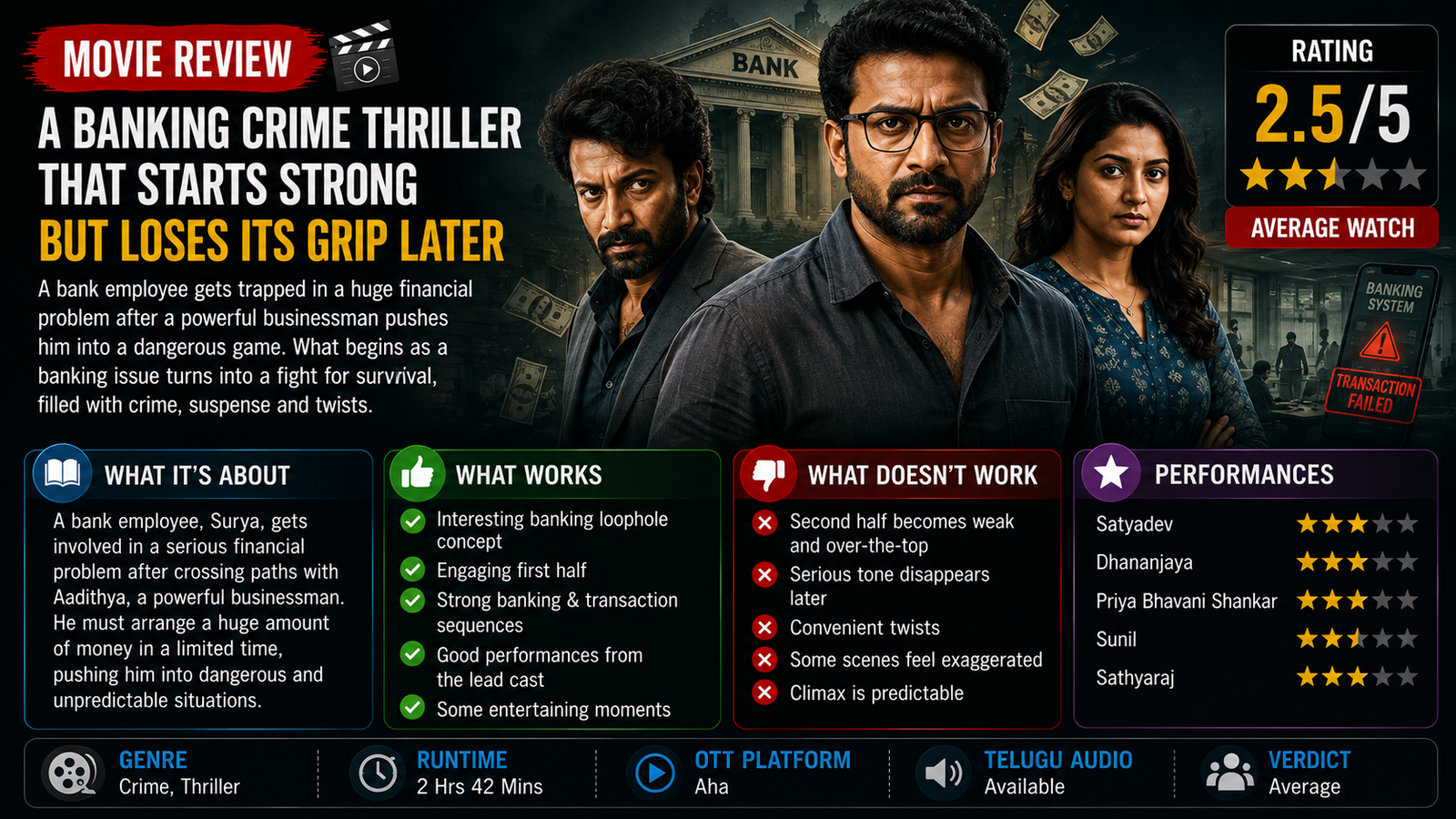
A Banking Crime Thriller That Starts Strong but Loses Its Grip Later
Banking-related crime stories have become increasingly interesting in Indian cinema, especially when they focus on loopholes, financial frauds, digital transactions and the risks hidden inside everyday banking systems. This film takes that route and tries to combine a banking scam with crime, suspense, comedy and action. The basic idea is interesting, and the opening portions create genuine curiosity by showing how a seemingly simple banking problem can turn into a serious situation for the protagonist. The film also benefits from a talented ensemble cast and a few well-written banking-related sequences. However, the biggest issue is that the seriousness and tension established in the beginning gradually disappear, and the screenplay starts depending more on cinematic conveniences and exaggerated situations. The result is an average crime thriller that has some very good stretches but does not maintain the same quality throughout. code 43
Zebra Movie Details
| Category | Details |
|---|---|
| Movie Name | Zebra |
| Release Year | 2024 |
| Language | Telugu |
| OTT Platform | Aha |
| Runtime | 2 Hours 42 Minutes |
| Genre | Crime, Thriller |
| Lead Cast | Satyadev, Dhananjaya, Priya Bhavani Shankar |
| Supporting Cast | Sunil, Sathyaraj and others |
| Rating | U/A 13+ |
| Telugu Audio | Available |
| OTT Release | Aha |
| Review Rating | 2.5/5 |
| Movie Link | Click Here |
Story and Basic Premise
The story revolves around the banking sector and the loopholes that exist within financial systems.
At the centre of the story is Surya, a bank employee who gets caught in a serious financial problem. What initially appears to be a banking-related issue gradually turns into something much bigger.
The situation becomes particularly complicated when Aadithya, a powerful and wealthy businessman, enters the picture.
Aadithya is not an ordinary character. He is presented as an egoistic and influential person who can create serious problems for anyone who crosses him.
Surya finds himself in a situation where he needs to arrange a huge amount of money within a limited period.
That immediately creates a do-or-die situation for the protagonist.
The interesting part is how the movie initially explains the banking loopholes and the ways in which transactions can be manipulated.
Rather than immediately jumping into action, the first part spends time establishing the financial problem.
This is where the movie is at its strongest.
Why Is the Movie Called Zebra?
The title has a symbolic connection to the central theme of the movie.
The film deals with the concept of black money and white money.
The contrast between black and white is reflected through the title “Zebra.”
This gives the title a connection to the financial crime aspect of the story.
The title therefore is not simply chosen because it sounds stylish.
It has a thematic connection with the film’s central idea of money, banking transactions and financial manipulation.
The Banking Angle Is the Biggest Attraction
The best part of the movie is the banking-related material.
In recent years, audiences have seen several films dealing with financial fraud and scams.
Banking loopholes, cybercrime, stock markets and financial manipulation have all become popular subjects.
This movie also enters that space.
The initial sections explain how certain banking loopholes can be exploited.
The screenplay tries to make the audience understand the problem along with the protagonist.
That approach works.
Instead of immediately presenting the protagonist as someone who can solve everything, the film places him in a difficult situation.
He has to figure out how to get out of it.
The audience therefore becomes interested in seeing what he will do next.
The First Half Is Much Better
The first half is undoubtedly the stronger portion.
The movie starts with a good amount of curiosity.
Surya’s problem is established, Aadithya’s character is introduced, and the financial stakes gradually become larger.
The banking-related sequences create genuine interest.
There is a particular stretch involving multiple transactions and banking loopholes that keeps the film engaging.
Until that point, the movie creates the feeling that the protagonist is genuinely trapped.
You begin wondering how he is going to handle the situation.
That is exactly what a crime thriller should achieve.
The audience should feel that the protagonist has limited options and that every decision could create another problem.
The first half manages to create that feeling.
The 41-Lakh Banking Sequence
One of the interesting stretches in the movie is the banking sequence involving the large financial amount.
The situation becomes increasingly complicated as the protagonist tries to manage the problem.
The film explains the banking process in a way that makes the audience curious about how the protagonist will escape.
This portion is one of the reasons the movie feels promising initially.
The banking loopholes are not simply mentioned as background information.
They become part of the actual conflict.
That makes the first half more engaging.
NRI and Banking Details
The movie also includes banking-related situations involving NRI accounts and active accounts.
These details help create a more realistic financial-crime atmosphere.
The film appears interested in showing how seemingly ordinary banking systems can contain loopholes that can be manipulated.
This is one of the aspects that makes the movie different from a conventional action thriller.
Instead of beginning with a traditional villain-versus-hero conflict, the movie starts with a financial problem.
That gives it a fresh flavour at least during the early stages.
Satyadev as Surya
Satyadev plays the central character Surya.
His performance is one of the strengths of the movie.
Surya is not introduced as an invincible hero.
He is an ordinary bank employee who suddenly finds himself in an extraordinary situation.
That makes his initial struggle believable.
Satyadev handles the character’s seriousness well.
He also performs the emotional and tense portions effectively.
His performance helps sell the financial crisis during the first half.
However, as the movie becomes more exaggerated, the character also gets pulled into situations that feel increasingly cinematic.
That reduces some of the realism established earlier.
Dhananjaya’s Character
Dhananjaya is another major attraction.
His character brings a different energy to the movie.
Compared with the serious banking investigation involving Surya, Dhananjaya’s portions introduce another dimension to the narrative.
His performance is strong, and he brings the required intensity to his role.
The contrast between his character and Surya gives the film additional conflict.
Dhananjaya has the kind of screen presence that can make even a relatively simple scene more engaging.
His performance is one of the reasons some of the later portions remain watchable despite the screenplay becoming weaker.
Priya Bhavani Shankar
Priya Bhavani Shankar is also part of the main cast.
Her character contributes to the emotional and narrative side of the story.
The performance is decent, although the character does not always receive enough material to create a major impact.
The movie is primarily driven by its crime and financial storyline, so the supporting emotional tracks are secondary.
Sunil and Other Supporting Actors
The supporting cast also performs well.
Sunil gets some lighter moments that help break the seriousness of the financial-crime portions.
These comedy elements are particularly useful during the later sections.
There are moments where the movie becomes very serious and then suddenly shifts towards humour.
Some of these sequences work because of the performers.
Others feel slightly disconnected from the main thriller.
Still, the ensemble cast generally does justice to their roles.
The Comedy Track
The movie includes comedy, especially through certain supporting characters.
The comedy is one of the better aspects when the film becomes too serious.
However, there is a problem with tonal consistency.
A crime thriller needs to maintain tension during important situations.
If a serious scene is immediately followed by exaggerated comedy, the tension can disappear.
That happens occasionally here.
The comedy itself is not necessarily bad.
The problem is where it is placed.
Some scenes involving Satyadev’s character and the supporting cast are entertaining, but the movie sometimes uses comedy at moments when the audience is supposed to be worried about the central conflict.
Where the Seriousness Disappears
This is the biggest weakness of the movie.
The beginning establishes a serious financial problem.
Surya appears to be in a genuine crisis.
The audience understands that his situation is dangerous.
But after a certain point, the film stops maintaining that seriousness.
The characters start behaving in ways that feel more cinematic.
Some situations become too convenient.
As a result, the tension that existed earlier starts disappearing.
The audience reaches a point where it no longer feels like the financial problem is truly dangerous.
That is a major issue for a thriller.
The Second Half
The second half is where the movie loses most of its momentum.
The screenplay becomes more focused on proceedings, challenges and action rather than the clever banking investigation that made the first half interesting.
Instead of continuously building the financial mystery, the film starts moving from one situation to another.
Some scenes are entertaining individually.
But when viewed as a complete story, they do not always connect convincingly.
The movie starts feeling more like a commercial entertainer than a grounded financial thriller.
Cinematic Convenience
One of the main criticisms is that several important scenes rely heavily on cinematic convenience.
In a crime thriller, the audience can accept some level of cinematic liberty.
But the film needs to establish its own rules and follow them.
Here, there are moments where the screenplay expects the audience to simply accept what happens.
For example, certain important objects and transactions are moved around or placed in locations in ways that feel convenient for the plot.
Instead of making the audience think, “That was cleverly planned,” the reaction can become, “How did that happen so easily?”
That difference matters.
The Stock Market Portion
The movie also introduces a stock-market-related portion.
The idea has potential.
Financial crime combined with stock-market manipulation could have created another strong layer to the story.
But again, the execution is not as convincing as the concept.
The movie introduces certain financial risks and then resolves them in ways that feel too easy or too sudden.
The audience is told that there is a significant risk involved, but the actual emotional impact of that risk is not always felt.
Action in the Climax
The climax shifts further towards action.
By this point, the movie has moved considerably away from its original banking-crime setup.
The action sequences attempt to provide a commercial ending.
However, the climax did not work particularly well for me.
The action is not necessarily poorly presented, but it does not provide the satisfying payoff that the first-half banking thriller seemed to promise.
The film also hints at the possibility of another part.
That decision may be interesting for audiences who enjoyed the characters, but the first movie itself needed a stronger standalone conclusion.
Does the Movie Have a Strong Mystery?
The film has enough mystery during the initial portions.
The audience is interested in knowing how Surya will overcome the financial problem.
The situation involving Aadithya also creates curiosity.
However, the mystery gradually becomes less important than the proceedings.
Once the movie shifts into larger-scale action and commercial drama, the investigative element loses some of its importance.
That is why the first half feels considerably stronger.
Screenplay Analysis
The screenplay has a good basic idea.
Banking fraud is a subject that can naturally generate tension.
A normal person getting trapped because of a financial transaction can create a strong emotional connection.
The film also has several characters who could have been used to develop a complex financial-crime story.
But the screenplay does not fully capitalize on that potential.
The first portion understands what kind of film it wants to be.
The later portions seem less certain.
They move towards action, comedy and commercial elements.
That makes the film feel uneven.
Direction
The direction has both strengths and weaknesses.
The filmmaker deserves credit for choosing a banking-crime subject.
The initial presentation is interesting.
The banking loopholes and financial transactions provide a strong foundation.
However, the execution becomes increasingly cinematic.
The director appears to prioritise entertaining moments over maintaining realism.
That decision may work for viewers who want a commercial thriller.
But for viewers expecting a tightly written financial crime story, it becomes a drawback.
Cinematography
The cinematography is decent.
The film has a polished commercial look.
Banking environments, urban locations and action sequences are presented effectively.
The visuals support the story without becoming a distraction.
However, cinematography is not the major highlight.
The real attraction lies in the concept and performances.
Background Music
The background score is serviceable.
It supports the action and tense sequences but does not leave a particularly strong impression.
There are no major complaints about the music, but it is also difficult to call it one of the movie’s biggest strengths.
The movie relies more heavily on its plot situations and performances than on its musical presentation.
Performances
| Actor | Performance |
|---|---|
| Satyadev | Strong and natural as Surya |
| Dhananjaya | Excellent screen presence and intensity |
| Priya Bhavani Shankar | Decent |
| Sunil | Good in lighter portions |
| Sathyaraj | Effective in his role |
| Supporting Cast | Generally good |
The performances are one of the most consistent aspects of the movie.
Even when the screenplay becomes weak, the actors keep the scenes watchable.
Telugu Audio and OTT Availability
The movie is available to stream on Aha.
For Telugu audiences, this makes it easily accessible without depending on subtitles.
Since the film is dialogue-heavy and involves banking terminology, watching it in a language you are comfortable with can make the proceedings easier to follow.
The OTT version is useful for viewers who missed the movie during its theatrical run and want to give it a try from home.
Content Advisory
The provided information lists the movie as U/A 13+.
The story contains crime, financial fraud, action and violence-related elements.
The review source also indicates that there are no adult scenes or bad language that would be a major concern for the reviewer.
However, parents should still consider the U/A 13+ rating when deciding whether younger viewers should watch it.
What Works in Zebra?
| Positive Aspect | Details |
|---|---|
| Banking Concept | Interesting subject |
| First Half | Stronger and more engaging |
| Banking Loopholes | Good attempt to explain financial problems |
| Satyadev | Natural performance |
| Dhananjaya | Strong screen presence |
| Supporting Cast | Generally effective |
| Comedy | Works in several portions |
| Production Quality | Decent |
| Telugu Availability | Easily accessible on Aha |
What Doesn’t Work?
| Negative Aspect | Details |
|---|---|
| Second Half | Loses the seriousness of the first half |
| Screenplay | Becomes inconsistent |
| Logic | Several scenes feel overly cinematic |
| Action | Does not always fit naturally |
| Stock Market Portion | Could have been executed better |
| Climax | Not very satisfying |
| BGM | Nothing particularly memorable |
| Runtime | 2h 42m feels long in places |
| Overall Impact | Does not maintain its promising beginning |
Is Zebra Worth Watching?
If you enjoy movies based on banking scams, financial frauds and crime, you can definitely give this movie a try.
The first half is good enough to make the movie worth checking out.
The banking loopholes and Surya’s financial crisis create genuine curiosity.
Satyadev and Dhananjaya also make the movie more watchable through their performances.
However, if you are expecting a completely realistic banking thriller, you may be disappointed.
The movie gradually becomes more commercial.
The second half contains several situations that require a greater suspension of disbelief.
The climax also does not provide the kind of satisfaction that the initial setup promises.
So this is not a must-watch recommendation.
It is better described as an average crime thriller with a promising concept.
Final Verdict
The biggest strength of the movie is its idea.
Banking fraud and financial loopholes are interesting subjects, and the film does a good job of making the first half engaging.
The opening portions create curiosity about how Surya is going to handle the financial crisis.
The banking-related scenes are among the best-written portions.
The introduction of Aadithya also gives the protagonist a strong opponent.
Satyadev performs well as Surya, while Dhananjaya brings considerable intensity and personality to his role.
The supporting cast, including Sunil and Priya Bhavani Shankar, also contributes effectively.
The problem begins when the film starts moving away from its grounded banking-crime setup.
The seriousness gradually disappears.
Some situations become overly cinematic, and the audience starts questioning the logic behind certain important developments.
The second half feels less focused.
The stock-market portions and action sequences have potential but are not executed strongly enough.
The climax, in particular, does not deliver the impact that the first half builds towards.
At 2 hours and 42 minutes, the runtime also feels lengthy because the screenplay does not maintain the same level of tension throughout.
Still, the film is not a complete disappointment.
There are several entertaining moments.
The performances are good.
The banking concept is interesting.
The first half is engaging.
The Telugu availability on Aha makes it an easy option for viewers who are interested in financial crime stories.
If you have already watched movies like Lucky Baskhar and are interested in another film involving banking and financial fraud, you may find some familiar territory here. However, the execution is different, and this movie does not reach the same level of consistency.
For me, the movie works well as a one-time watch if you have the time and enjoy crime thrillers.
But it is not something I would strongly recommend dropping everything else to watch.
The first half gives you the feeling that you are watching a clever banking thriller.
The second half turns it into a more conventional commercial crime-action film.
That difference is ultimately what prevents the movie from becoming a truly memorable experience.
Final Rating: 2.5/5
Verdict: An Interesting Banking Crime Thriller With a Strong First Half, Good Performances and Some Clever Financial Concepts, But the Overly Cinematic Second Half, Inconsistent Screenplay and Weak Climax Reduce Its Overall Impact.
OTT: Aha
Runtime: 2 Hours 42 Minutes
Release Year: 2024
Genre: Crime, Thriller
Lead Cast: Satyadev, Dhananjaya, Priya Bhavani Shankar
Age Rating: U/A 13+
Telugu Audio: Available