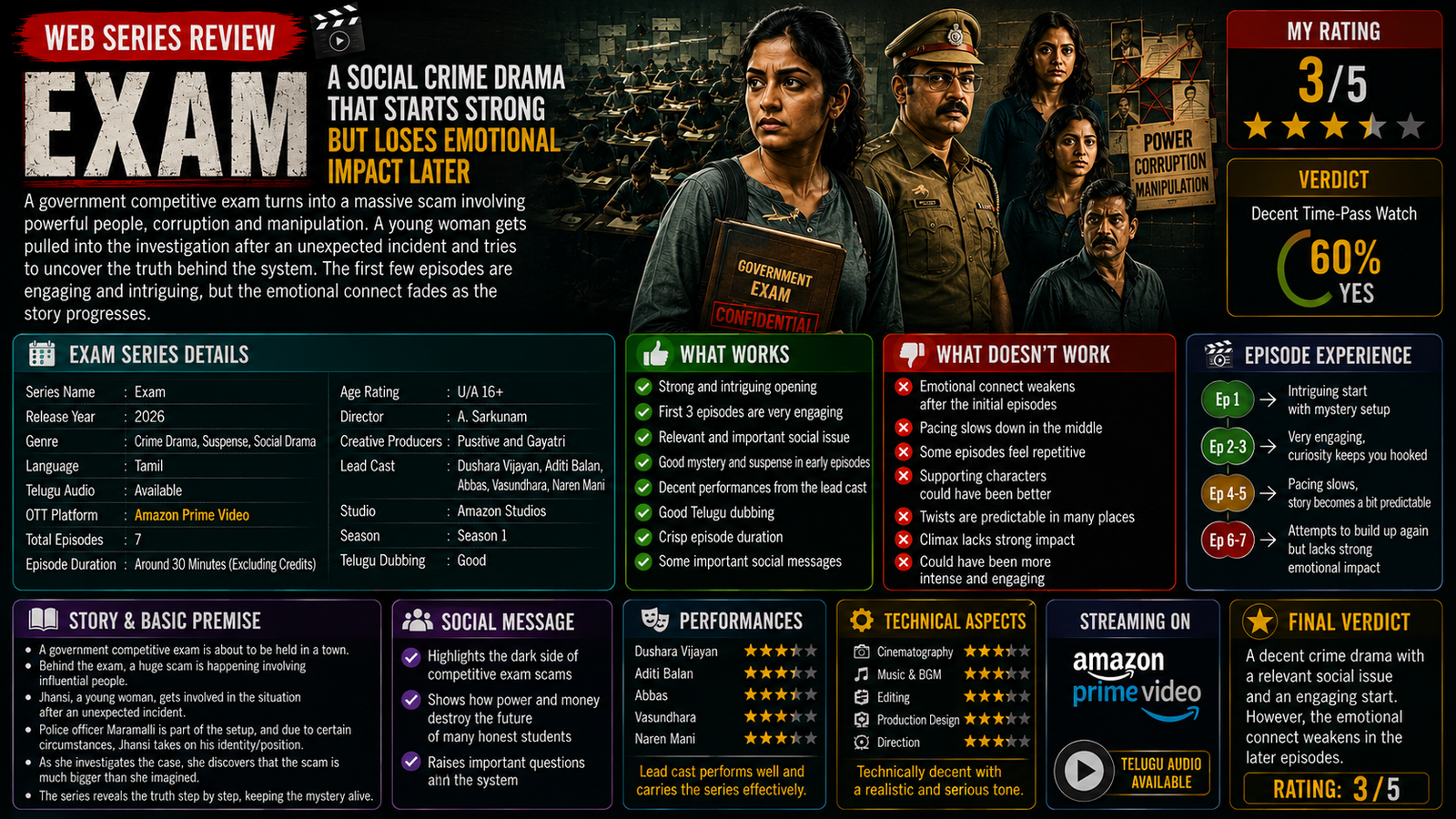
A Social Crime Drama That Starts Strong but Loses Emotional Impact Later
Government competitive examinations are often presented as a symbol of opportunity, especially for young people from ordinary backgrounds who depend on them to change their lives. But what happens when the system surrounding those examinations becomes corrupted? What happens when influential people manipulate the system for their own benefit, while ordinary students are left to deal with the consequences? This crime drama series takes that idea and builds a story around an examination scam, police investigation and the people connected to a system that is much bigger than it initially appears. The opening episodes create curiosity with a mysterious incident and a strong setup, and the first few episodes are genuinely engaging. The series also attempts to highlight several social issues connected to power, corruption and the misuse of authority. However, as the story progresses, the emotional connection with the characters gradually weakens, making the later episodes less impactful than the promising beginning. Code : 40

Exam Series Details
| Category | Details |
|---|---|
| Series Name | Exam |
| Release Year | 2026 |
| Genre | Crime Drama, Suspense, Social Drama |
| Language | Tamil |
| Telugu Audio | Available |
| OTT Platform | Amazon Prime Video |
| Total Episodes | 7 |
| Episode Duration | Around 30 Minutes excluding credits |
| Age Rating | U/A 16+ |
| Director | A. Sarkunam |
| Creative Producers | Pushkar and Gayatri |
| Lead Cast | Dushara Vijayan, Aditi Balan, Abbas, Vasundhara, Naren Mani |
| Studio | Amazon Studios |
| Season | Season 1 |
| Telugu Dubbing | Good |
| Verdict | Decent Time-Pass Watch |
| Rating | 3/5 |
| Movie Link | Click Here |
Story and Basic Premise
The story revolves around a government competitive examination scam.
The events take place around a town where a major government competitive examination is scheduled to take place within a week. The examination is supposed to be an opportunity for candidates who have prepared for a long time and are hoping to secure a better future.
But behind the examination system, something much darker is happening.
The story introduces Jhansi, a young woman whose life becomes connected with the larger investigation.
At the same time, a police officer named Maramalli is involved in the setup. Due to an unexpected incident, Jhansi ends up taking on the identity or position associated with the police investigation.
This immediately creates several questions.
Who exactly is Jhansi?
What is her actual background?
Why does she need to enter this situation?
What happened to Maramalli?
What is the connection between Jhansi and the examination scam?
And most importantly, how deep does the scam actually go?
The series gradually answers these questions while introducing different characters and layers of the system.
Rather than revealing everything immediately, it tries to build the mystery step by step.
The Opening Episodes Are Engaging
The strongest portion of the series is its beginning.
The opening episode establishes a backstory that immediately creates curiosity.
You do not completely understand what is happening, but you know there is something important behind the characters and their actions.
That is an effective way to begin a thriller.
Instead of simply presenting the examination scam directly, the series gives us a mystery surrounding its central characters.
The first three episodes are particularly engaging.
The story slowly moves from the initial incident toward the larger examination scam.
At this stage, there is enough mystery to keep you watching.
You want to know what happened.
You want to know who is responsible.
You want to understand why Jhansi has entered this situation.
The screenplay creates enough questions to make the next episode feel necessary.
That is a major positive.
The Examination Scam Concept
The central concept is relevant and socially important.
Competitive examination scams have become a serious subject of discussion in recent years, particularly because examinations can determine the future of thousands of students.
The series uses this subject to explore how a system can be manipulated by people with power and influence.
The story suggests that corruption does not necessarily exist at just one level.
There can be different people involved at different stages.
Some may directly participate in wrongdoing.
Others may know about it but choose not to act.
And some people may have the authority to change the situation but use that authority only for their own benefit.
That is one of the more interesting social observations in the series.
Power and Corruption
One of the key themes is the relationship between authority and responsibility.
The series shows higher-level officials who have the ability to change the system.
They have the power to take action.
They can make decisions that affect ordinary people.
But instead of using that power to correct the problem, they sometimes use the system to protect themselves or people close to them.
This is where the series attempts to make a larger social statement.
It is not simply saying that one person is corrupt.
It is trying to show how an entire system can become compromised when people in positions of authority stop acting responsibly.
That aspect gives the series more relevance than a straightforward police investigation.
Jhansi’s Character
Jhansi is one of the central characters of the story.
Her entry into the larger investigation creates the main curiosity factor.
The audience is not given all the answers about her immediately.
Instead, the series gradually reveals more about her.
This is one of the reasons the opening episodes work well.
The mystery surrounding her identity and motivations makes us want to continue watching.
However, the problem is that the emotional connection with the character does not remain as strong as the initial curiosity.
The audience understands that she is important to the story, but the screenplay could have spent more time developing her emotional side.
Knowing a character’s purpose is not the same as emotionally connecting with that character.
That difference becomes increasingly noticeable in the later episodes.
Character Development Is the Main Weakness
This is where the series loses some of its potential.
The concept is strong.
The social issue is relevant.
The opening is interesting.
But after around three episodes, the emotional connection with the characters begins to weaken.
The story continues moving forward, but the audience may not feel as emotionally invested in the people involved.
For a crime drama, this can be a significant problem.
The audience needs to care about what happens to the characters.
If a character is in danger, we should feel concerned.
If a character succeeds, we should feel happy.
If a character loses something important, the moment should carry emotional weight.
Here, the series does not always achieve that.
The characters are functional for the plot, but not all of them are developed deeply enough to create a strong emotional bond.
The Backstory
The series contains a backstory that is initially quite intriguing.
When it is introduced, it creates several questions.
You start wondering how this particular story will connect to the main examination scam.
The mystery surrounding the backstory becomes one of the reasons to continue watching.
However, when everything is finally revealed, the overall impact is not as powerful as expected.
The problem is not necessarily the idea itself.
The problem is the emotional preparation.
Because the audience has not developed a strong enough connection with the characters involved, the revelation does not hit as hard as it potentially could have.
This is another example of how stronger character writing could have improved the series.
Social Issues
The series does deserve credit for attempting to discuss real social problems.
The examination scam is only one part of the larger discussion.
The show also looks at how systems can favour people with influence.
It questions what happens when people who have the power to correct a problem decide not to use it.
It also highlights the consequences faced by ordinary people when powerful individuals manipulate institutions.
These ideas give the series some substance.
It is not purely designed as entertainment.
There is a clear attempt to make the audience think about the system and the people affected by it.
Relevance to Current Times
The examination scam storyline feels particularly relevant because competitive examination irregularities and paper leaks have been major subjects of public discussion.
The series therefore arrives at a time when the subject feels familiar to viewers.
Whether this similarity is intentional or simply coincidental is difficult to say from the series alone, but the subject certainly feels connected to current social conversations.
That relevance helps the story feel contemporary.
The series is not dealing with an outdated or disconnected issue.
It is talking about a system that directly affects students, families and young people looking for government employment.
Crime Drama Elements
The crime element of the series works reasonably well.
The investigation gives the story forward momentum during the first half.
There are questions surrounding the scam, the people involved and the reasons behind the different actions.
The police angle also provides the series with a procedural structure.
However, the investigation could have been more gripping.
There are moments where the story progresses without generating enough tension.
This becomes more noticeable after the first few episodes.
The initial mystery makes you expect the series to become increasingly intense, but the later portions do not always maintain that level of engagement.
Suspense
The suspense is strongest at the beginning.
The series starts with enough unanswered questions to keep viewers curious.
The mystery surrounding Jhansi is particularly effective.
The audience wants to understand what is actually happening.
But once certain answers begin arriving, the suspense becomes less powerful.
The story becomes more focused on progressing toward the larger conflict.
This makes the later episodes feel more straightforward.
A stronger second half could have turned this into a much more gripping thriller.
Pacing
The pacing is reasonably good during the initial episodes.
Since each episode is relatively short, the series is easy to move through.
Each episode runs for around 30 minutes excluding the credits, and there are seven episodes in total.
That makes the entire season fairly manageable.
However, the pacing of the story itself is not equally strong throughout.
The first three episodes are more engaging.
Later, the narrative starts feeling less exciting even though important developments are still happening.
The problem is not necessarily the runtime.
It is the way the screenplay handles the character and emotional portions.
Seven-Episode Structure
The seven-episode structure works reasonably well for this kind of story.
The short episode duration makes the series easy to binge.
There is enough content in each episode to move the plot forward without making individual episodes excessively long.
However, the short format also means that certain characters and emotional developments do not receive as much attention as they deserve.
A few additional scenes focused on character development could have made the later revelations much more effective.
Performances
The performances are one of the positives.
The actors take the material seriously and deliver convincing performances.
Dushara Vijayan is particularly important to the series because the story depends heavily on her character.
Her performance helps maintain the seriousness of the narrative.
The supporting cast also performs well.
Nobody feels completely out of place.
Even when the writing becomes less engaging, the performances help keep the scenes watchable.
The acting is therefore not the reason the series loses momentum.
The bigger issue is the writing and emotional development.
Telugu Dubbing
For Telugu-speaking viewers, the good news is that the Telugu dubbing is handled well.
The dialogue does not feel excessively awkward or distracting.
The dubbed version maintains the overall tone of the original material.
Since the series depends heavily on conversations, investigation and character interactions, good dubbing is important.
Thankfully, the Telugu audio makes the show accessible to viewers who do not want to watch it in Tamil.
If you prefer Telugu content, you can comfortably choose the Telugu version on Prime Video.
Cinematography
The cinematography is decent.
The locations help establish the atmosphere of the story.
The town and surrounding environments provide an appropriate setting for a crime drama based around a government examination scam.
The visuals are not necessarily the biggest highlight of the show, but they do their job effectively.
There are no major technical issues that take you out of the story.
Music and Background Score
The music is also decent.
The background score supports the suspense and dramatic moments without becoming overly distracting.
It does not completely transform the series, but it contributes to the atmosphere.
For a crime drama, the BGM needs to support tension and uncertainty.
Here, it generally works adequately.
Production Quality
The overall production quality is good.
The series looks professionally made.
The locations, camera work, performances and editing are all reasonably polished.
There is nothing particularly problematic from a technical standpoint.
The biggest limitation remains the screenplay rather than the production.
Adult Content and Family Viewing
The series does not depend on explicit adult content.
According to the provided viewing information, there is no major adult-content track that would be the primary concern.
However, the series carries a U/A 16+ rating and includes elements such as violence, fighting, tobacco depictions, alcohol use and strong language.
So while it does not appear to be an adult-content-heavy show, viewers should still consider the age rating before watching it with younger family members.
What Works in Exam?
| Positive Aspect | Review |
|---|---|
| Concept | Relevant examination scam storyline |
| Opening | Strong and curiosity-driven |
| First 3 Episodes | Engaging |
| Social Commentary | Addresses corruption and misuse of power |
| Performances | Strong overall |
| Telugu Dubbing | Good |
| Runtime | Easy to binge |
| Cinematography | Decent |
| Music | Decent |
| Production | Professionally handled |
What Could Have Been Better?
| Weakness | Review |
|---|---|
| Character Development | Emotional connection weakens after the first few episodes |
| Later Episodes | Less engaging than the opening |
| Backstory Payoff | Does not deliver a strong emotional impact |
| Screenplay | Could have developed characters more deeply |
| Suspense | Not consistently maintained |
| Emotional Writing | Needed stronger character-based moments |
| Overall Impact | Concept is stronger than execution |
Is Exam Worth Watching?
If you are interested in social dramas involving government examinations, corruption and crime, this series is worth trying.
The first few episodes are genuinely engaging.
The premise is relevant, the mystery creates curiosity and the Telugu dubbing is good.
The series is also short enough to finish without requiring a huge time commitment.
However, I would not call it a must-watch thriller.
The main reason is the drop in emotional engagement after the first three episodes.
The story continues, but the characters do not always develop enough to make the audience deeply invested in their outcomes.
If the character development had been stronger, the same story could have had considerably more impact.
Final Verdict
Overall, this is a decent crime drama that has a good concept and a relevant social issue at its centre.
The examination scam storyline is interesting, especially because it connects a familiar social problem with a police investigation and a mysterious central character.
The opening episodes are the strongest part of the series.
The initial backstory creates curiosity, and the gradual movement into the main plot works well.
The first three episodes are engaging enough to make you want to continue.
The series also deserves appreciation for discussing the misuse of authority.
It shows how people in powerful positions can influence a system and how those with the ability to make changes may choose to protect their own interests instead.
That social commentary gives the show some substance.
The major problem comes after the initial setup.
Once the mystery begins developing, the emotional connection with the characters becomes weaker.
The audience may understand what is happening but does not always feel strongly connected to the people involved.
The backstory is another example.
It starts with enough mystery to make us curious, but when the complete picture emerges, the emotional impact is not as strong as expected.
The actors perform well, but good performances can only partially compensate for underdeveloped character arcs.
Technically, the show is decent.
The cinematography, locations and music are all satisfactory.
The Telugu dubbing is also good, which makes the series easier to watch for Telugu audiences.
With seven episodes of approximately 30 minutes each, it is also a relatively easy binge.
If you are looking for a short crime drama with a socially relevant concept, you can give it a try.
If you expect a highly gripping thriller with powerful character arcs and a hard-hitting emotional payoff, you may find it only average.
For me, the series is somewhere in the middle.
It is not bad.
It is also not as strong as the concept suggests it could have been.
The biggest positive is the subject.
The biggest negative is the lack of strong emotional character development.
Final Rating: 3/5
Recommendation: 60% Yes
Verdict: A Decent Crime Drama With a Relevant Examination Scam Concept, Strong Opening Episodes and Good Performances, But It Needed Better Character Development and a More Impactful Payoff.
OTT Platform: Amazon Prime Video
Telugu Audio: Available
Total Episodes: 7
Episode Duration: Around 30 Minutes Excluding Credits