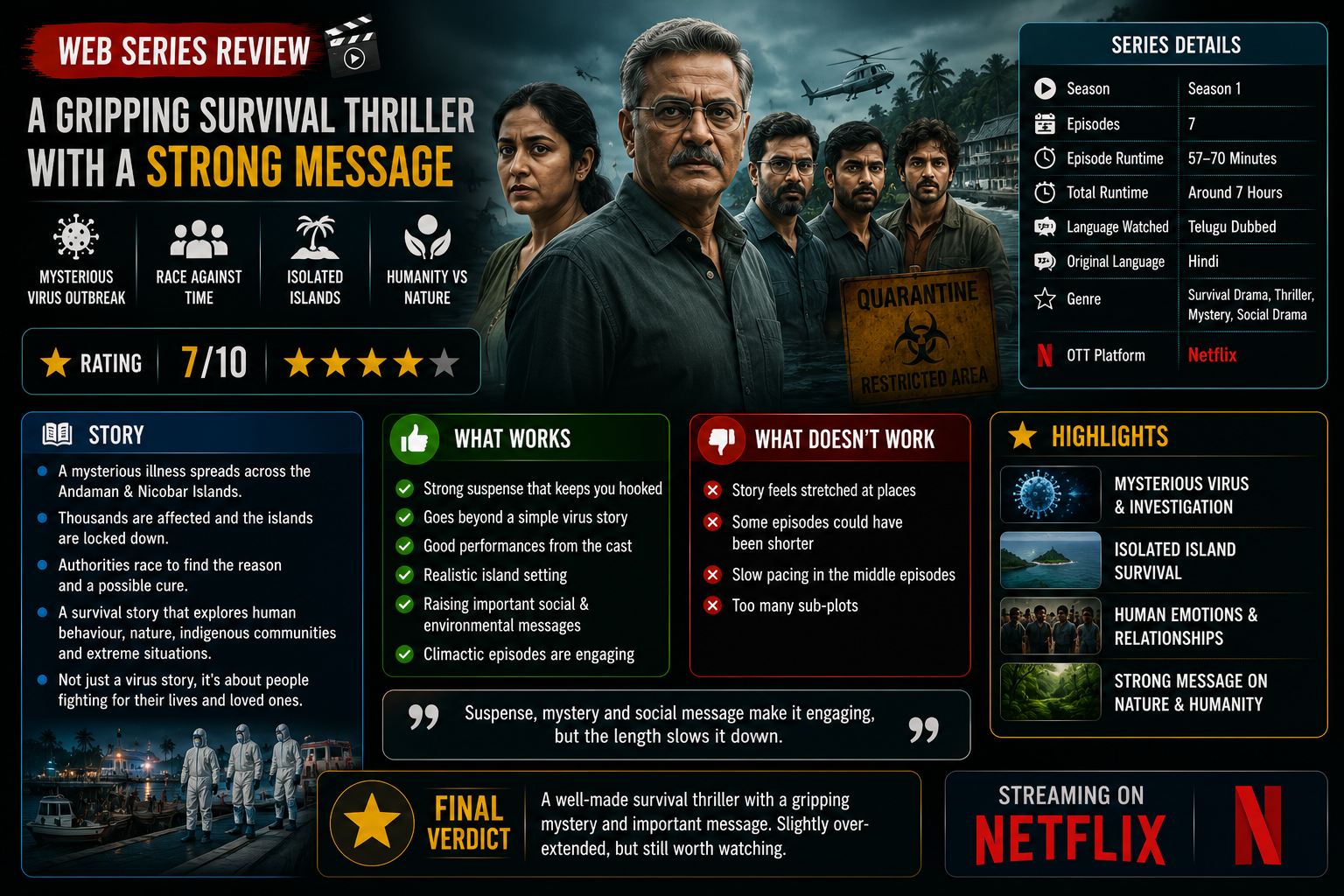
A Gripping Survival Thriller That Takes Too Long to Tell Its Story
A mysterious illness suddenly begins spreading across the Andaman and Nicobar Islands, and within a short period of time, the situation turns into a massive survival crisis. As thousands of people are affected, the authorities are forced to take extreme measures to understand the disease, search for a possible cure and control the situation. Code : 35
But this is not simply a story about a dangerous virus.
The series also explores human behaviour during a crisis, the relationship between people and nature, the importance of indigenous communities, government decisions, personal survival and the lengths people are willing to go to protect themselves and their families.
That combination makes Kaala Paani an interesting survival thriller. However, there is also one major issue: the series is quite long for the story it wants to tell. At several points, the narrative feels stretched, and some episodes could have been shorter.
The series has 7 episodes, with episodes running roughly between 57 minutes and 1 hour 10 minutes.
Kaala Paani Web Series Details
| Category | Details |
|---|---|
| Series | Kaala Paani |
| Season | Season 1 |
| Release Year | 2023 |
| Original Language | Hindi |
| Language Watched | Telugu Dubbed |
| Genre | Survival Drama, Thriller, Mystery, Social Drama |
| Episodes | 7 |
| Episode Runtime | Approximately 57–70 Minutes |
| Total Runtime | Around 7 Hours |
| OTT Platform | Netflix |
| Telugu Audio | Available |
| Hindi Audio | Available |
| Tamil Audio | Available |
| English Audio | Available |
| Main Cast | Ashutosh Gowariker, Mona Singh, Sukant Goel, Amey Wagh, Vikas Kumar and others |
| Rating | 7/10 |
| Overall Verdict | Good, but slightly overextended |
Netflix officially lists the series as a 2023 drama with seven episodes and describes it as a story about a mysterious illness spreading through the Andaman and Nicobar Islands, where survival becomes a race to find a cure.
Story and Basic Premise
The story is set in the Andaman and Nicobar Islands.
The location itself becomes extremely important because the islands are isolated from the mainland. When a mysterious illness begins spreading, the situation quickly becomes complicated.
Initially, the authorities have to understand what exactly is happening.
Why are people falling sick?
What is causing the illness?
How quickly is it spreading?
Is there a cure?
Can the disease be controlled?
And most importantly, can people escape the islands before the situation becomes completely uncontrollable?
These questions form the foundation of the series.
The first episode establishes the mysterious illness while a major festival brings thousands of tourists to Port Blair. Dr. Soudamini Singh becomes involved in investigating the illness, while other characters are dealing with their own personal problems.
As the outbreak develops, the islands are placed under lockdown.
Flights are cancelled.
Movement becomes restricted.
The outside world becomes increasingly difficult to reach.
Suddenly, the beautiful island environment becomes something completely different.
It becomes a place where people are trapped.
That is where the survival aspect of the story really begins.
The Biggest Strength: Suspense
The biggest positive for me is the suspense.
While watching the series, you repeatedly feel that the characters are close to finding an answer.
You think a cure is about to be discovered.
You think someone has finally understood the source of the disease.
You think the authorities have figured out what is happening.
Then suddenly, the story takes another turn.
That keeps the viewer connected to the screen.
The series repeatedly creates questions without immediately providing answers.
Will they find the cure?
Who will survive?
What exactly is causing the disease?
Can the people escape?
What role do the indigenous tribes play?
Why are certain characters behaving differently?
These questions keep running in the viewer’s mind.
That is one of the main reasons I continued watching the series even when some portions felt slow.
The Mystery Behind the Disease
The illness is obviously the central mystery.
However, the series does not treat it as just another virus-outbreak story.
There are several layers attached to it.
The investigation gradually brings different characters, locations and communities into the narrative.
The indigenous tribes are especially important to the larger mystery.
The series uses their relationship with the islands and their knowledge of nature as an important part of the story.
This gives the narrative another dimension.
Instead of making the entire story about doctors and government officials, the makers expand it into a story involving different communities.
That makes the world feel bigger.
Different Characters and Their Stories
Another major strength is the character development.
There are many important characters in the series, and the makers spend considerable time exploring their backgrounds.
You learn why a particular person behaves in a certain way.
You understand what happened to them in the past.
You see their fears.
You understand their priorities.
And when the crisis becomes worse, you see how those personalities change.
This is particularly effective because the series does not make every character behave like a typical hero.
Everyone has different priorities.
Some people want to save their families.
Some want to survive themselves.
Some want to discover the cure.
Some are thinking about the larger population.
Others are simply trying to escape.
That creates interesting conflicts between the characters.
The Human Side of the Story
The series does a good job of showing human nature during an emergency.
When thousands of people are suddenly facing a dangerous disease, normal rules begin to change.
People start thinking differently.
A person who normally appears calm may become desperate.
Someone who seems selfish may make a surprising sacrifice.
Another person may put their family above everyone else.
This is one of the most interesting aspects of the series.
The story essentially asks a simple question:
How far would a person go to survive?
Would you risk yourself to save someone else?
Would you sacrifice another person to save your family?
Would you follow government instructions even if you believed they were wrong?
Would you stay behind if escaping meant leaving someone you love?
The series explores these questions through its characters.
Santosh Is an Emotional Character
One character that particularly worked for me was Santosh.
He is travelling with his family in the Andaman and Nicobar Islands, and once the crisis begins, his priorities completely change.
His primary concern becomes protecting and reuniting with his children.
The emotional connection with this character develops gradually.
The series spends enough time with the characters that you begin to understand their individual situations.
That makes the survival situations more impactful.
Netflix’s episode descriptions also specifically highlight Santosh’s struggle to reunite with his children after the islands go into lockdown.
Ashutosh Gowariker’s Performance
Ashutosh Gowariker is another important part of the show.
His character represents the authority side of the story and becomes involved in the decisions that need to be taken as the crisis develops.
His performance is controlled and serious.
He does not try to make every scene dramatic.
Instead, his character is presented as someone who has to make difficult decisions under enormous pressure.
That works well for the story because the character is constantly placed between government responsibility and the human consequences of those decisions.
Mona Singh’s Performance
Mona Singh is another major strength.
Her character is directly connected to the investigation into the mysterious illness.
The scientific and medical side of the story depends heavily on her character.
Her performance helps give those portions credibility.
She manages to balance the professional side of the character with the emotional pressure created by the situation.
The character does not simply sit around waiting for other people to solve the problem.
She actively tries to understand the illness and find answers.
Amey Wagh and the Supporting Cast
The supporting cast also contributes strongly.
Amey Wagh brings a different energy to the story, while Sukant Goel, Vikas Kumar, Arushi Sharma, Radhika Mehrotra and Chinmay D. Mandlekar add their own layers to the ensemble.
Netflix officially lists Ashutosh Gowariker, Mona Singh, Sukant Goel, Amey Wagh, Vikas Kumar, Arushi Sharma, Radhika Mehrotra and Chinmay D. Mandlekar among the main cast.
The ensemble approach works because the series is not dependent on one protagonist.
There are multiple storylines moving simultaneously.
Indigenous Tribes and Their Culture
One of the more interesting aspects is the inclusion of different indigenous communities.
The series does not simply use the islands as a beautiful tourist location.
It also explores the people who have a much deeper connection with the land.
Their culture, traditions and understanding of nature become relevant to the mystery.
This adds something different to the series.
It also gives the story a stronger sense of place.
The island is not just a background location.
It affects the story.
It affects the characters.
It affects the investigation.
And it eventually becomes an important part of understanding the larger problem.
Locations and Cinematography
The locations are another major positive.
The Andaman and Nicobar Islands provide a visually striking environment.
The series uses beaches, forests, villages, roads and isolated areas to create different moods.
At the beginning, the island looks beautiful and peaceful.
Once the epidemic spreads, the same environment starts feeling isolated and threatening.
That contrast works well.
The cinematography also helps establish the scale of the crisis.
However, this is where one of my biggest criticisms comes in.
The Problem With the Length
The biggest negative is the runtime.
The first season runs for around seven hours in total.
Each of the seven episodes is close to an hour, with some going beyond that. Netflix lists runtimes ranging from about 57 minutes to 1 hour 10 minutes.
Personally, I felt that this story did not necessarily need that much runtime.
Yes, the longer format allows the writers to develop the characters.
Yes, it gives us more information about their backgrounds.
Yes, it allows multiple storylines to exist.
But at the same time, several portions feel extended.
There are moments when you feel that the story could have moved faster.
Instead of spending so much time developing certain portions, the narrative could have been tightened.
This is particularly noticeable when you watch several episodes continuously.
The first few episodes may keep you interested, but eventually you start feeling that the series is taking longer than necessary to reach the next major development.
World War Z Comparison
While watching the show, one comparison that naturally came to my mind was World War Z.
Both deal with a large-scale outbreak and the question of how humanity reacts when a dangerous disease threatens huge numbers of people.
However, the presentation is very different.
World War Z is a much shorter movie and focuses heavily on the immediate threat.
Kaala Paani spends considerably more time on individual characters and their personal journeys.
That character development is one of the show’s strengths.
But it is also the reason for its biggest weakness.
Because the makers spend so much time with the characters, the actual epidemic sometimes feels less terrifying than it should.
The Epidemic Does Not Always Feel Massive
This is probably my biggest criticism after the runtime.
The story repeatedly tells us that thousands of people are dying.
But as a viewer, you do not always feel the scale of that disaster.
You hear about the number of deaths.
Characters discuss the crisis.
Authorities talk about the seriousness of the situation.
But visually, the series does not always show the full magnitude of the epidemic.
Instead, the story often focuses on one or two people at a time.
That is understandable because this is primarily a character-driven survival drama.
But if the series wants the audience to feel the horror of a massive epidemic, there should be more moments where the scale of the disaster becomes visible.
The audience should feel:
“This is much bigger than these individual characters.”
Sometimes that feeling is missing.
The Virus Should Have Felt More Terrifying
The disease itself is supposed to be the biggest threat.
But because the show concentrates heavily on individual character stories, the danger of the virus occasionally feels secondary.
You understand that it is dangerous.
You understand that people are dying.
You understand that the islands are under lockdown.
But you do not always experience the same level of fear that the characters are supposed to be experiencing.
That reduces some of the impact.
A more balanced approach between character development and the actual epidemic could have made the thriller much stronger.
Pacing Issues
The pacing is inconsistent.
There are episodes where the story moves beautifully.
Then there are portions where it slows down considerably.
The third episode, for example, focuses heavily on Santosh and his attempt to reunite with his children, while other storylines continue developing in parallel. Netflix’s official episode descriptions reflect how the series gradually shifts attention between different characters and mysteries.
The fourth and fifth episodes introduce more information about the tribes, the past and the possible cure.
These elements are important, but the narrative sometimes feels stretched.
By the time the series reaches the sixth episode, the story becomes more focused again.
The sixth episode brings an important discovery involving the possible cure, while the seventh episode moves toward evacuation and the final moral dilemma. (Netflix)
The Later Episodes Become More Interesting
The second half becomes more focused on finding a solution.
The characters are no longer simply trying to understand what is happening.
They are now trying to act.
The search for a possible cure becomes more important.
The relationship between the disease and the indigenous tribe becomes increasingly relevant.
The pressure on the characters also increases.
By the final episode, thousands of people are preparing to leave the island, and the authorities are faced with an extremely difficult decision.
That gives the finale a stronger sense of urgency.
Social and Environmental Themes
The series also has something to say about environmental damage and human interference with nature.
This is where the story becomes more than a simple virus thriller.
The narrative connects the epidemic to larger questions involving nature, human activity, corporations and indigenous communities.
That makes the series more ambitious.
It is not just asking:
“How do we stop the virus?”
It is also asking:
“Why did this happen?”
“What role did humans play?”
“Who benefits from exploiting natural resources?”
“What happens when commercial interests come into conflict with local communities?”
These themes add depth to the story.
The Corporate Angle
The corporate component is another important layer.
The series shows how commercial interests can influence decisions during a crisis.
This becomes particularly interesting because the authorities are not operating in isolation.
Different groups have different priorities.
Some are thinking about public safety.
Some are thinking about business.
Some are thinking about political consequences.
Some are simply trying to survive.
That conflict makes the story more realistic.
Does the Series Feel Realistic?
In terms of character behaviour, yes, to a considerable extent.
People react differently to extreme situations.
Some panic.
Some become aggressive.
Some become protective.
Some make selfish decisions.
Others take risks for strangers.
This variety in human behaviour is one of the show’s better qualities.
The series does not assume that everyone will behave heroically during a disaster.
That makes the characters feel more believable.
Telugu Dubbed Version
The series is available in Telugu on Netflix.
Netflix officially lists Telugu alongside Hindi, Tamil and English audio options.
For Telugu viewers, the availability of a dubbed version makes the series easier to watch.
The story has several technical and investigative conversations, so a good dub is important.
The Telugu version is useful for viewers who prefer watching this type of content in their native language.
Is Kaala Paani Worth Watching?
Yes, but with one important condition.
You should be prepared for the long runtime.
If you enjoy slow-burn survival thrillers and character-driven dramas, you can definitely give it a try.
If you are expecting a fast-paced virus thriller with continuous action, you may find it slow.
This is not a series where every episode is filled with dramatic action sequences.
Instead, it spends a lot of time building characters and exploring the situation.
So your expectations matter.
What Works in Kaala Paani?
| Positive | Opinion |
|---|---|
| Story Concept | Interesting |
| Suspense | Very Good |
| Character Development | Excellent |
| Performances | Strong |
| Locations | Excellent |
| Cinematography | Very Good |
| Indigenous Culture | Interesting |
| Human Behaviour | Realistically Presented |
| Mystery | Engaging |
| Social Themes | Strong |
| Telugu Dub | Good |
| Climax | Decent |
What Does Not Work?
| Negative | Opinion |
|---|---|
| Runtime | Too Long |
| Pacing | Uneven |
| Epidemic Scale | Not Always Effectively Shown |
| Virus Threat | Could Have Felt More Dangerous |
| Some Episodes | Feel Extended |
| Overall Execution | Could Have Been Tighter |
Final Verdict
Overall, Kaala Paani is a good survival thriller with strong characters, interesting ideas and enough suspense to keep you watching.
The biggest reason I enjoyed the series is the way it develops its characters.
Almost every major character gets enough attention to understand their background, psychology and motivations.
That creates an emotional connection.
The suspense is another major positive.
Throughout the series, you keep wondering when the characters will find the cure, whether they will survive and what is actually happening behind the epidemic.
The locations and cinematography are also excellent.
The Andaman and Nicobar Islands provide a beautiful but isolated setting, and the series uses that isolation effectively.
The indigenous tribes and their culture add another layer to the narrative.
However, the series is definitely longer than necessary.
Seven episodes with runtimes close to an hour each can feel excessive, especially when some portions of the story move slowly.
The biggest missed opportunity is the scale of the epidemic.
The story repeatedly tells us that thousands of people are dying, but the audience does not always visually experience that level of devastation.
Because of that, the virus sometimes feels less frightening than it should.
If the series had been slightly shorter and had shown the scale of the epidemic more effectively, the overall impact could have been much stronger.
Still, I would not call the series boring.
There is enough suspense, character development and mystery to keep you engaged.
If you can comfortably invest around seven hours, I would recommend giving it a chance.
If you are looking for something fast-paced that can be finished quickly, you may want to skip it.
For me, the overall experience was positive, but the runtime definitely affected the final rating.
Rating
| Category | Rating |
|---|---|
| Story | 7.5/10 |
| Screenplay | 7/10 |
| Suspense | 8/10 |
| Character Development | 8.5/10 |
| Performances | 8/10 |
| Cinematography | 8.5/10 |
| BGM | 7.5/10 |
| Pacing | 6/10 |
| Climax | 7.5/10 |
| Overall | 7/10 |
OTT Streaming Details
| Details | Information |
|---|---|
| Series | Kaala Paani |
| Season | Season 1 |
| OTT | Netflix |
| Episodes | 7 |
| Episode Runtime | Approximately 57–70 Minutes |
| Original Language | Hindi |
| Telugu Audio | Available |
| Tamil Audio | Available |
| Genre | Survival Drama, Thriller |
| Setting | Andaman and Nicobar Islands |
| Overall Rating | 7/10 |
Netflix’s official page confirms the seven-episode first season and the availability of Telugu audio, along with Hindi, Tamil and English.
Kaala Paani is worth watching if you like survival dramas, mystery thrillers and stories that focus heavily on characters.
It may not be the fastest survival thriller you will watch, and the seven-hour runtime is definitely more than what the story strictly requires. But the strong character development, suspense, performances, cinematography, island setting and social themes make it an engaging series.
The show also succeeds in making you think about how people behave when survival becomes the only priority.
The biggest drawback is that the epidemic itself does not always feel as terrifying as the story tells us it is.
So, my final verdict is simple: good series, strong characters, good suspense, but slightly overextended.
If you have around seven hours available and enjoy this genre, you can watch it.
Kaala Paani – 7/10