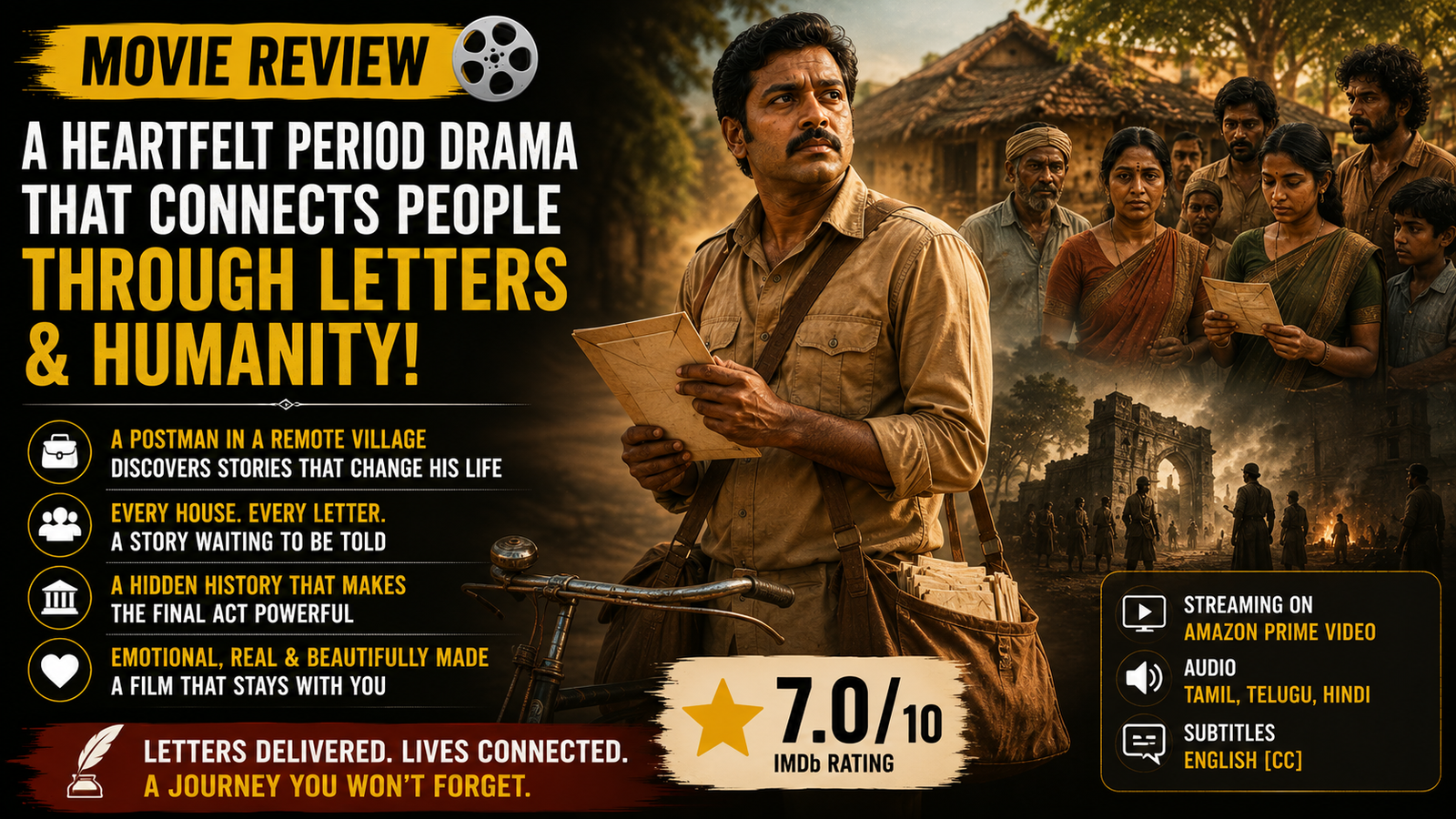
A Moving Period Drama About Humanity, History and a Forgotten Village
Some films do not depend on big action sequences, commercial entertainment or star power to keep the audience interested. Instead, they slowly build an emotional connection through their characters, locations and storytelling. This is one such film. Set against the backdrop of a remote village and the postal system, the movie combines history, drama and human emotions in a simple but deeply engaging manner. Code : 21

The story takes us into a world that feels completely different from modern life. A government employee is assigned to work as a postman in a remote village where the people, traditions and lifestyle seem to belong to another era. Initially, he struggles to understand the place and its people. His frustration with the job and his desire to leave the village become an important part of the narrative.
What begins as a simple story about a postman gradually develops into something much deeper. As he starts visiting different houses and interacting with the villagers, he discovers their personal stories, relationships, struggles and secrets. Eventually, the history of the village becomes an important part of the film and gives the story an emotional depth that makes the final portion particularly impactful.
Harkara Movie Details
| Category | Details |
|---|---|
| Movie | Harkara |
| Genre | Drama, History |
| Language | Tamil |
| Runtime | Approximately 1 Hour 51 Minutes |
| Director | Ram Arun Castro |
| Cast | Banu, Balu Bose, Ram Arun Castro |
| Production | Dheena Productions, Kalorfultbeta Movement, Paradigm Pictures |
| OTT Platform | Amazon Prime Video |
| IMDb Rating | 7.0/10 |
| Audio Languages | Tamil, Telugu, Hindi |
| Movie Link | Click Here |
Story and Plot
The story revolves around a man who gets a government job as a postman and is sent to work in a remote village. Instead of feeling happy about receiving a government position, he becomes frustrated with his new surroundings.
The village is very different from the world he is accustomed to. The people follow traditional customs and their lifestyle appears to be several decades behind the modern world. The protagonist finds it difficult to adjust to the environment and starts looking for an opportunity to transfer out.
He approaches his senior officer and requests a transfer, hoping to escape from the village. However, his request is rejected.
This forces him to continue working there.
As part of his job, he begins travelling from house to house delivering letters and interacting with different families. These seemingly ordinary encounters slowly become an important storytelling device.
Every house has a story.
Every person has a past.
And every letter becomes a small connection between people.
The movie gradually moves beyond the protagonist’s frustration and begins exploring the lives of the villagers. What initially looks like an ordinary posting slowly turns into an emotional journey through the history of the village.
The film becomes particularly interesting when the audience begins discovering that the village has a much deeper and darker history than what initially appears on the surface.
A Simple Concept That Becomes Powerful
The biggest strength of the movie is its basic concept.
A postman may appear to have a simple job. He delivers letters and moves from one house to another. But in the process, he becomes a silent witness to the lives of ordinary people.
The film uses this idea beautifully.
Instead of making the postman just another character, the screenplay uses his profession as a way to introduce us to the village. Through his work, we get to see different families, different relationships and different emotions.
This makes the narrative feel natural rather than forced.
The movie does not rush to reveal everything. It takes its time and gradually builds the world around the protagonist.
Screenplay and Storytelling
The screenplay is one of the strongest aspects of the film.
The first portion establishes the protagonist and his uncomfortable relationship with the village. His frustration makes sense because the audience is also introduced to an unfamiliar environment.
As the story progresses, the focus slowly shifts from the postman’s personal problems to the people living in the village.
That transition works well.
The movie keeps adding small details, conversations and incidents that eventually become important to the larger story. This makes the audience pay attention to seemingly minor moments.
The screenplay also succeeds because it does not reveal the village’s entire history immediately. Instead, information is provided gradually.
This creates curiosity about what actually happened in the past.
Emotional Connect
The emotional aspect of the movie is another major positive.
Initially, the protagonist sees the village as a place he wants to escape from. But as he spends more time there, his perspective begins to change.
The people he initially considers strange slowly become familiar to him.
Their stories begin to matter.
Their problems become more personal.
This emotional transformation is handled effectively.
The final portion, in particular, carries considerable emotional weight. Once the history of the village comes to light, several earlier scenes take on a different meaning.
Some viewers may genuinely find themselves getting emotional during the climax.
Performances
The performances suit the grounded nature of the film.
The lead performance effectively communicates the protagonist’s frustration, confusion and gradual emotional transformation. Rather than making the character overly dramatic, the performance remains relatively natural.
The supporting characters also contribute significantly to the film.
Since the story spends considerable time with the villagers, the supporting performances are important. The characters feel like ordinary people rather than exaggerated movie characters.
That realism helps the audience connect with the village.
Village Setting and Visual Appeal
The village setting is one of the most memorable elements.
The film takes us into a natural environment filled with greenery, forests and traditional surroundings. The locations give the movie a distinct identity.
The contrast between the protagonist’s modern outlook and the village’s traditional lifestyle is visually and narratively effective.
The greenery and forest locations also add a unique atmosphere to the film.
Instead of depending heavily on artificial sets, the movie benefits from its natural surroundings.
Direction
Ram Arun Castro handles the film with patience.
The director does not try to turn the story into a conventional commercial entertainer. The focus remains on the characters, village, history and emotions.
That approach may not work for viewers who expect fast-paced entertainment, but for people who enjoy slow-burn dramas and stories based on human emotions, the direction can be rewarding.
The film’s ability to connect a simple profession with the larger history of a village is particularly interesting.
What Works Well
There are several things that work in favour of the movie:
- Unique village-based concept
- Strong emotional core
- Interesting use of the postman’s profession
- Engaging screenplay
- Natural performances
- Beautiful green and forest locations
- Strong atmosphere
- Gradual revelation of the village’s history
- Emotional final portion
- Relatively short runtime
The movie does not unnecessarily stretch its story. With a runtime of around 1 hour 51 minutes, it manages to tell its story without becoming excessively lengthy.
What May Not Work for Everyone
At the same time, this is not a film for viewers looking for constant action or commercial entertainment.
The movie takes its time to establish the characters and surroundings. Some portions may feel slow, especially for audiences who prefer fast-paced thrillers.
The film is more focused on atmosphere, characters and emotions than on conventional twists.
Therefore, viewers should approach it as a period drama and emotional village story, rather than expecting a typical commercial movie.
Why You Should Watch It
If you enjoy films that slowly reveal their stories, this movie is worth considering.
The film starts with a simple premise involving a government employee and a remote posting. But the narrative gradually expands into a story about people, relationships, history and the forgotten lives of villagers.
The most interesting aspect is the way the protagonist’s profession becomes the bridge between the audience and the village.
The postman enters different homes, meets different people and unknowingly becomes connected to the larger history of the place.
That makes the film more meaningful than its basic premise might suggest.
OTT Availability
The movie is available to stream on Amazon Prime Video. The OTT listing also indicates Tamil, Telugu and Hindi audio options, along with English subtitles.
This makes it easier for viewers from different language backgrounds to experience the film.
Overall, this is a thoughtful and emotionally driven period drama that deserves attention from viewers who enjoy realistic storytelling.
The movie begins as a simple story about a postman who is unhappy with his government posting. But as the story progresses, it transforms into a much larger narrative about a remote village and the history hidden within it.
The screenplay keeps the audience connected through small stories, character interactions and gradual revelations. The performances are natural, the village locations look beautiful and the emotional payoff in the final portion gives the film additional impact.
It may not be the right choice if you are looking for a fast-paced commercial entertainer. But if you enjoy slow-burn dramas, historical stories, village-based narratives and emotional storytelling, this is definitely worth giving a chance.
Rating
My Rating: 8/10
Verdict: A beautifully grounded and emotional village drama that slowly grows into a powerful story about people, history and human connections.
Where to Watch
OTT Platform: Amazon Prime Video
Languages: Tamil, Telugu, Hindi
Subtitles: English
If you have already watched the movie, share your opinion about the story, performances and climax. The emotional journey of the characters is certainly the aspect that stays with you after the movie ends.